
 There’s something special about being there when “the light bulb goes on,” when students who have been wrestling with a concept finally get it, seeing the world in a different way that allows them to understand it more fully. This is one of the primary reasons I was excited to join McREL’s science, engineering, technology, and mathematics (STEM) team, which brings emerging STEM content, specifically nanoscience and technology (NS&T), to classrooms in a way that helps students truly grasp it.
NS&T has the potential to transform our world as much or more than plastics did in the 1960s. This science involves the manipulation of matter at the nano scale, at 10-9 m. This is even smaller than the “world” you can see with a microscope. Need a quick catch-up? This cool three-minute video from the Nanoscale Informal Science Education Network (NISE Net) explains succinctly the potential applications of NS&T.
In 2004, McREL began wondering: Is it possible to teach nanoscale science to high school students? To answer this question, McREL undertook a project—dubbed “A NanoLeap into New Science” and affectionately shortened to NanoLeap—the results of which were astounding to me. NanoLeap showed that not only is it possible to teach emerging, complex, real-world science to high school students, but it actually helps them learn core content better. That’s right, the students who grappled with nanoscience learned more about fundamental science concepts than their peers. (For complete project findings or to download the free curriculum, click here.)
McREL’s work continued with an even more ambitious task: to provide the pedagogical tools needed to effectively integrate emerging science into their respective curricula—content in which teachers themselves had little background. To this end, McREL developed NanoTeach, a professional development model that integrates McREL’s pedagogical framework, Designing Effective Science Instruction (DESI) with NS&T. I came in mid-way through this ambitious project and helped educators make necessary shifts in their mindset and classrooms to foster student engagement in this cutting-edge science.
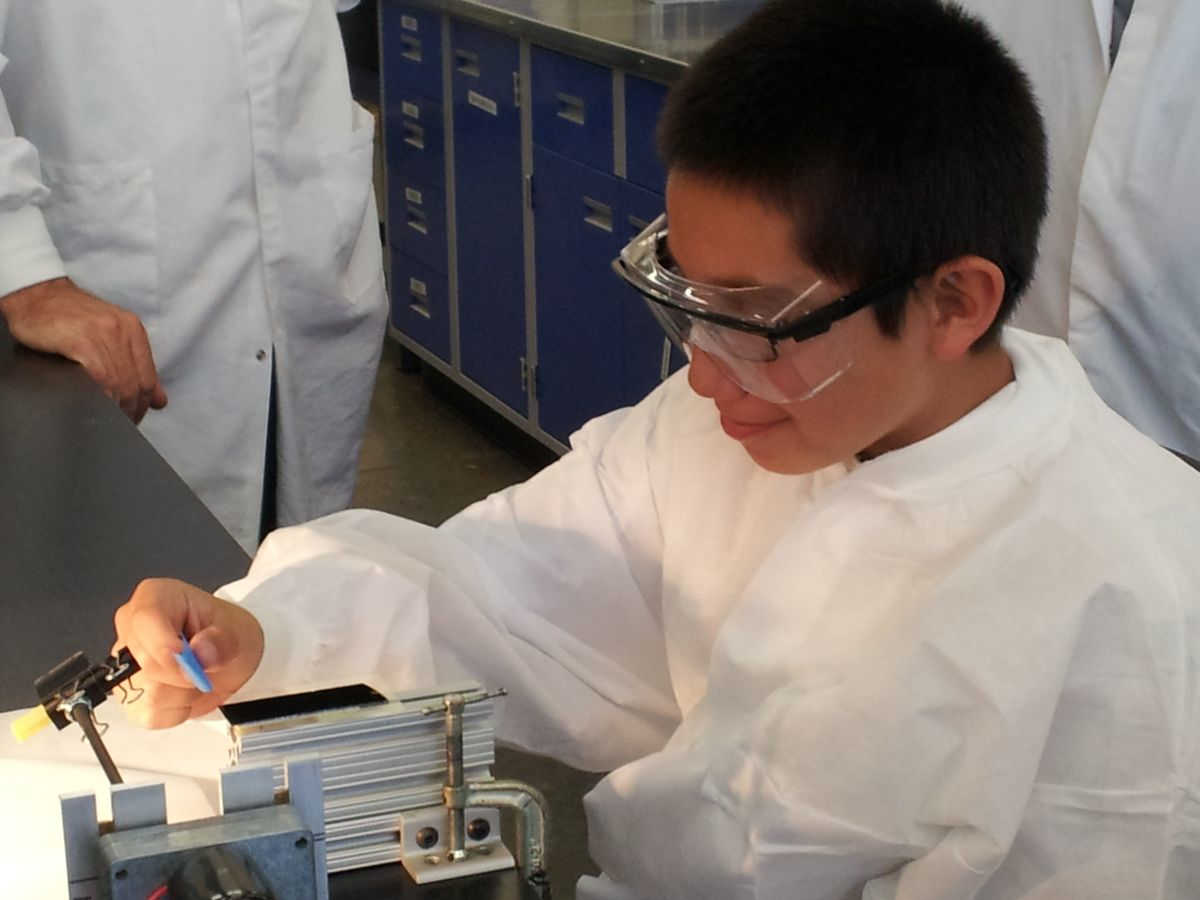 Most recently, McREL’s work integrating emerging science into students’ lives intensified with NanoExperiences, a program designed to connect students directly with nanoscience careers. In working with these students, I’ve witnessed the power STEM-infused learning has on the student experience: Suddenly, the content is intense, exciting—motivating!
Nanoscale science and technology can change students’ perception of the world around them and gives them the opportunity to learn about, understand, and be part of current scientific innovation. To me, this is the best of science education—finding a way for “the light bulb” to go on for all learners.
 Sandra Weeks is a STEM consultant for McREL. She designs K‒12 instructional materials and professional development on a variety of STEM topics, including NanoExperiences and NanoTeach.
